By Jon Courson —
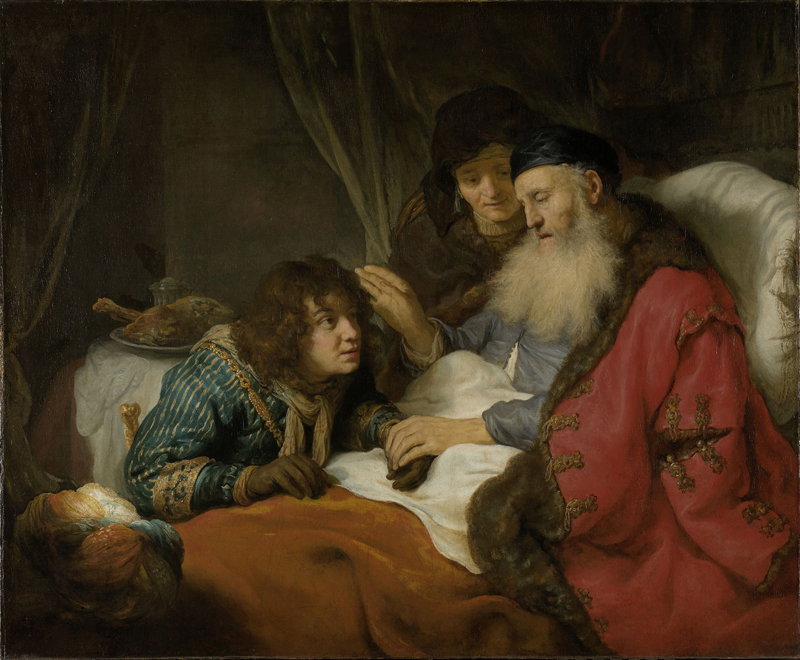
Esau said to his father, “Do you have only one blessing, my father? Bless me, even me also, O my father.” So Esau lifted his voice and wept. Then Isaac his father answered and said to him, “Behold, away from the fertility of the earth shall be your dwelling, and away from the dew of heaven from above; And by your sword you shall live, and your brother you shall serve. But it shall come to pass when you become restless, that you shall break his yoke from your neck. Genesis 27:38-40
In other words, “You’ll be under your brother’s authority, Esau, fighting for your very life. But there will come a season when you will break loose from the yoke of his dominion over you.” I believe what is spoken here has huge prophetic implication. You see, God’s anger at the Edomites, the descendants of Esau, appears throughout the Old Testament—seen nowhere more clearly than in the Book of Obadiah, the only book in the Old Testament devoted to an indictment against a single group of people.
Why does God wage war against the Edomites? An Edomite named Haman sheds light on the reason, for in the Book of Esther, we read of his plan to annihilate the Jews. Then, around the year 300 B.C., a group called the Nabateans took control of the area where the Edomites lived southeast of Israel. Driven out of their homeland, the Edomites settled around Hebron—part of the West Bank today—and became known as Idumeans.
Years later, when the Macabbeans rose up and overthrew the Syrians who had taken control of Jerusalem, the Macabbeans said to the people living in Idumea, “We’ll let you stay here only if you convert to Judaism.” So the Idumeans became Jews religiously, although they remained Edomites ethnically.
Around the year 47 B.C., Julius Caesar appointed Antipater—an Idumean—as governor of the region. Antipater was the father of Herod, and Herod being a family name, all of the Herods who followed were Idumean, including the Herod who ordered the death of every male child under two years of age in an attempt to kill the Babe of Bethlehem.
From generation to generation, God declares, “I wage war against the descendants of Esau” (Ezekiel 25:14) because from the very beginning there’s a spirit at work. It’s the spirit to destroy the Jewish nation and prevent Messiah from surviving. It’s the spirit of antichrist.
In the year A.D. 70, the Romans, led by General Titus, were positioned to destroy the city of Jerusalem. Josephus tells us 20,000 Idumeans were let in the city gates by the Jews because they promised to help fight the Romans. But once inside, the Idumeans turned against the Jews and slaughtered them. (1)
The surviving Jews scattered; the Idumeans migrated to Italy, settling around the city of Rome, where their descendants are to this day. Why Rome? Because through Herod, there was a linkage to the Romans. According to Daniel 9, antichrist shall be of the people who destroyed the city of Jerusalem. Who destroyed Jerusalem? The Romans. Thus, the nationality of antichrist will most likely be Roman, but his ethnic background will be Idumean because prophecies throughout the Old Testament indicate that he will be linked ethnically to Esau.
God is not capricious or unfair when He says, “I hate Esau” (Romans 9:13) because there’s a spirit which travels through Esau’s descendants directly to antichrist. When is the day Esau will beat the yoke of Jacob from off his neck? I suggest it is the day antichrist rises to power and sets up his image in the temple in Jerusalem (Matthew 24:15).
(1) Consider these minor clarifications on timing and details. This aligns closely with the historical account given by Flavius Josephus in his work The Jewish War (also known as The Wars of the Jews), Book 4, chapters 4–5.
Here’s a breakdown based on Josephus’s eyewitness-based narrative (he was a Jewish defector to the Romans who chronicled the events):
- Roman positioning in A.D. 70: The Romans, under General Titus (son of Emperor Vespasian), did indeed besiege and position themselves to destroy Jerusalem starting in early spring A.D. 70 (around March/April, coinciding with Passover). The siege began then, and the city was fully invested, leading to its fall and the Temple’s destruction in August A.D. 70.
- The Idumeans (Edomites) and the 20,000 figure: Yes, Josephus reports that 20,000 Idumeans (a people from southern Judea/Idumea, often allied or in conflict with Jews) were summoned as allies by the radical Zealots (a militant Jewish faction that had seized control of parts of the city and the Temple). The Zealots, led by figures like Eleazar ben Simon and influenced by John of Gischala, were in conflict with more moderate Jewish leaders (like the high priest Ananus) who favored negotiation or peace with Rome. The Zealots sent messengers urging the Idumeans to come help defend the city against what they claimed was betrayal to the Romans.
- Let in by the Jews (Zealots): The city’s gates were initially closed against the Idumeans by the moderate faction, so the 20,000 camped outside. But a group of Zealots, taking advantage of a stormy night (with thunder, wind, and possibly an earthquake mentioned by Josephus), secretly cut the gate bars or opened them undetected. This allowed the Idumeans to enter the city.
- Turning against the Jews and slaughter: Once inside, the Idumeans did not fight the Romans (who were still outside besieging). Instead, they allied with the Zealots and turned on the city’s inhabitants—particularly the moderates, guards, and ordinary people suspected of opposing the radicals. Josephus describes a night of horrific massacre: They slaughtered guards at the Temple, killed prominent leaders like Ananus and Jesus (son of Gamaliel), looted houses, and killed indiscriminately. He states that day dawned upon 8,500 dead from the initial rampage, with the violence continuing (including torture and imprisonment of nobles, leading to thousands more deaths). The Idumeans showed no mercy, treating fellow Jews as enemies, and the streets ran with blood.
This event occurred in late A.D. 68 or early A.D. 69 (during the civil strife inside Jerusalem, before Titus’s full siege tightened in 70). It was part of the internal factional chaos that weakened the city and hastened its fall to the Romans. Josephus portrays it as a tragic, self-destructive episode where Jews slaughtered Jews more brutally than the external enemy.
Courson’s statement is accurate in substance—Josephus is the primary source, and modern histories (e.g., Wikipedia on the Zealot coup, Britannica on the Siege, and scholarly summaries) confirm this sequence without contradiction. Minor notes: The “Jews” who let them in were specifically the Zealot faction (not all Jews), and the slaughter targeted perceived moderates/collaborators rather than a random anti-Jewish betrayal, but the outcome was indeed a massacre of fellow Jews. — Grok
Taken from Jon Courson’s Application Commentary by Jon Courson Copyright © 2003 by Jon Courson. To order his commentary, go here