By Brian Nixon —
In an age of celebrity pastors, it’s nice to pick up a book and read the “About the Authors” section: “Jeremy Ashworth and Fred Bernhard are pastors. Both are nice, neither is famous.”
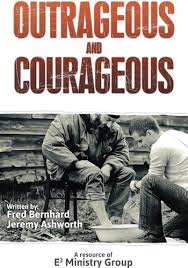
The book I’m holding is Outrageous and Courageous.
To some, “nice” and “not famous” may be an off-handed slight, but for me, it’s refreshing.
As the description on the back of Outrageous and Courageous states, “This is a book about making friends and sharing faith.”

As the Pastor of Circle of Peace church in Peoria, Arizona, I reach out to Pastor Jeremy Ashworth to discuss both topics mentioned: How to make friends and share your faith, as well as how Ashworth “imagines” church—as a Princeton Theological Seminary article— notes.
If you were to give an elevator pitch for Outrageous and Courageous, what would it be?
How to talk about Jesus without being a jerk.
I was particularly interested in the content of chapter 3, “Reluctant Evangelists.” In the chapter you review various statements about people’s hesitancy to share their faith. Why is evangelism important for the local church—and the broader mission of people following Jesus?
Without evangelism, none of us would be here. Evangelism is not a program of the church; the church is the result of evangelism. And God designed evangelism to be mutually transformative. We bless others, but we ourselves are blessed in the process. I also think that it’s especially important for believers who do not think of themselves as particularly evangelistic to pick up the task of sharing the faith. It’s true that many of us feel an inner resistance to sharing our faith. But often, we resist the thing we need the most.
Why is friendship important for evangelism to be effective?
We have a relational gospel and a relational God. We believe in having a personal relationship with a personal God. So, if this is at the heart of what we believe, it makes zero sense for us to be distant, unfriendly, or impersonal as we share this message.
 I really liked the section in chapter 6, “Extending Invitations.” In it, you give “Ten-Non-Commandments.” What are these, and how do these tips make sharing your faith more effective?
The 10 non-commandments were my attempt to give some practical tips on extending invitations in Jesus’ name. For example, #1 is “Make It Golden,” meaning, apply the Golden rule to evangelism. How would you want to be invited to something? Go and do likewise. #4 is “Be resilient.”. This means that inviters must be tough. We must be willing to accept no for an answer. We also need to accept the fact that people will ghost, flake out, or cancel at the last minute. It’s just part of the process. #5 is “Volume Counts,” which hopefully speaks for itself. Invitation is never a one-to-one investment. If you invite 10 people to your wedding, maybe only five people will show. And if that’s true for your wedding, how much more is that true for church?

In a Princeton Theological Seminary article on Circle of Peace, they highlight how you’re “Imaging Church.” As a community church—with ties to a historic denomination—how do you make church relevant and real for people in our contemporary culture?
You really need to know your context. I see myself as a missionary to the suburbs. I take my kids to a local school, I hike on the hills in our neighborhood, I have a minivan and a mortgage like everybody else. But I know that my Jesus-Centered value system makes me different than some of my neighbors. Think of it this way: When I was in seminary, I wrote papers and sermons in a form and format that would be acceptable to my professors. But now that I’m in the field, my professors are no longer my audience. So, I need to relate and communicate in such a way that my neighbors will give me a hearing.
To learn more about Circle of Peace church, click here: https://circleofpeacechurch.com.
To learn more about the book and to order, go here