By Mark Ellis —
When my grandmother, Kathryn Gomes, passed away, I was sifting through her library to see which books would be keepers in my own collection.
I stumbled on an old book, written in 1896, called The Mighty Atom by Marie Corelli. In the frontispiece of the book, Corelli wrote this:
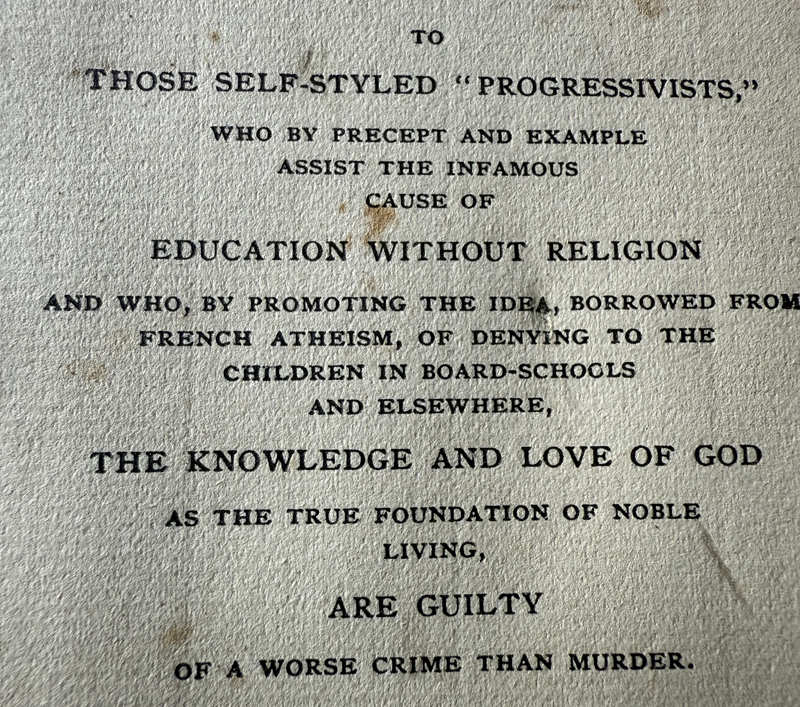
“To those self-styled ‘progressivists’, who by precent and example, assist the infamous cause of education without religion, and who, by promoting the idea, borrowed from French atheism, of denying to the children in board-schools and elsewhere, the knowledge and love of God as the true foundation of noble living, are guilty of a worse crime than murder.”
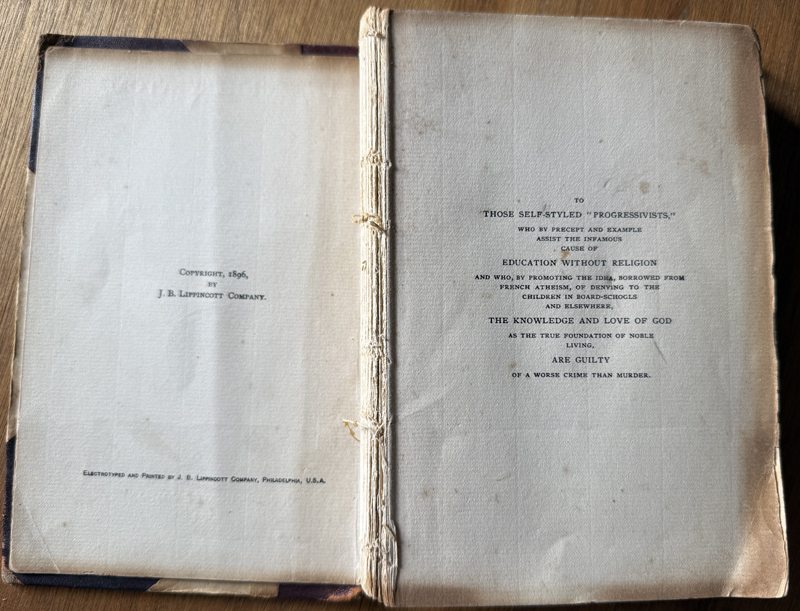
While Corelli, a pseudonym for Mary Mackay, was not an orthodox Christian, and attempted to blend Christian ideas with reincarnation and mysticism, she nonetheless accurately predicted the problems that have arisen as a result of secular, “progressive”, atheistic education, and the moral catastrophe that has befallen generations of young people.
The first K-12 surveys of schools began in 1870. At that time, drug addiction and mental health issues were very minor, with disruptive behaviors noted as part of urbanization and industrialization.
Marijuana use was first associated with behavior issues in urban schools by the 1930s–1940s, particularly among minority groups, according to the Federal Bureau of Narcotics. Drug problems were still low compared to today, with alcohol more prevalent in youth behavior.
Mental health services in schools started around 1900, with the first school-based clinics in the U.S. addressing “problem children” through psychological evaluations. By the 1920s, surveys on adolescent mental health highlighted issues like anxiety from urbanization and immigration, but data is still limited from that period.
In the 1920s, disruptive behavior was linked to poverty and lack of supervision, with no serious widespread concerns until the 1950s.
In the early 1960s, a series of U.S. Supreme Court rulings removed state-sponsored prayer and Bible reading:
Engel v. Vitale (1962): The Court struck down a New York policy requiring the recitation of a state-written prayer in public schools, even if it was voluntary.
Abington School District v. Schempp (1963): The Court ruled that school-sponsored Bible readings and recitation of the Lord’s Prayer were unconstitutional in public schools.
Drug use, behavior issues, and mental health problems have soared since then, with mental health problems increasing dramatically since the 2010s, according to Monitoring the Future (MTF).
Fighting and antisocial behavior have increased, with 2023 data indicating 70% of schools reporting disruptive incidents, up from earlier decades, NCES surveys noted.
Recent trends show cyberbullying and violence rising, with 15% of students affected by disruptive behavior. Overall, disruptive behaviors have become more digital and mental-health-related.
By contrast, The Cardus Education Survey (2018–2023), conducted by the Cardus Institute, compared outcomes for students in public, Catholic, evangelical Protestant, and other private schools.
Key findings from the 2023 report show that faith-based schools have higher academic achievement, with graduates from Christian schools more likely to attend college (82% vs. 76% for public school grads) and report higher life satisfaction.
Private Christian schools had fewer behavioral problems and better teacher-student relationships compared to public schools.
Students from Christian schools are more involved in community service and voting.
The survey highlighted faith-based schools’ edge in overall development, with Christian schools outperforming public schools in spiritual and social outcomes.
In summary, surveys reveal that Christian K-12 schools often outperform public schools in academic achievement, spiritual formation, critical thinking, and civic engagement, with narrower achievement gaps. These contrasts highlight the benefits of faith-based education.
Also, 65% of Gen Z report feeling disconnected from absolute truth, according to a 2024 Barna Group study. Christian education counters this by anchoring students in God’s unchanging Word.
Christian schools foster communities of character, where virtues like kindness, integrity, and service are modeled daily. At Saddleback Church’s Christian School in Lake Forest, California, students participate in service projects, from feeding the homeless to supporting global missions.
Christian education isn’t without challenges. Tuition costs, averaging $8,000–$15,000 annually for K-12 schools, can strain families, though scholarships and church partnerships often bridge the gap (Cardus Education Survey, 2023). Homeschooling using Christian curriculum is an alternative increasingly considered, especially since the Covid-19 pandemic.
In a world filled with moral ambiguity, gender confusion, and violent antisocial behavior, Christian education stands as a beacon of truth, grounding students in biblical principles and equipping them to navigate life’s challenges.
As families seek alternatives to secular systems, Christian education is preparing the next generation for a world in need of Jesus.