By Brian Nixon —
Poet William Stafford (b. 1914) died 32 years ago, on August 28, 1993. For many of us, he was the saint of silent writers. A quiet, often unassuming presence, he encouraged those who yearned to write— but just didn’t have enough confidence, verve, or knowledge on how to proceed. He called us to “revise our life.”
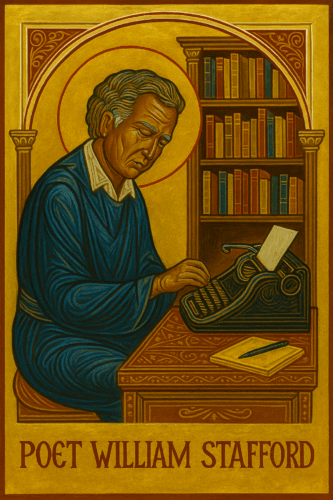
Stafford was our guide.
He knew persistence paid off. His first notable book of poems wasn’t published until he was 46 years old, released in 1960 (West of Your City). And it wasn’t until 1962’s, Traveling Through the Dark, that Stafford caught the attention of the broader writing community.
True, he wrote a book for the Christian denomination he was often associated with, the Church of the Brethren, 1947’s Down in My Heart, but he didn’t publish any notable books between 1947 and 1960.
During these silent years Stafford honed his craft (often in the early morning), taught, and raised a family: Life’s poetry. He built experiences he’d later share through his many works. His poet son, Kim Stafford, writes about his father during this flourishing period in the book Early Morning: Remembering My Father, William Stafford.
Through his books and lectures, William Stafford was the calm authority that stimulated the voiceless to find a voice. As a Christian pacifist, Stafford didn’t encourage a war with words, but a way with words, a means to transform a life.
I was first introduced to William Stafford in college, where his poem “Traveling Through the Dark” was read with revere by our professor. And later Stafford’s work was highlighted in one of our college textbooks, helping children learn to write well.
But it wasn’t until my involvement with the Church of the Brethren in the 1980’s that Stafford took on stratospheric heights. I started to collect his work, even the rare and hard to find books. And missing him read at the Church of the Brethren’s Annual Conference, still stands as one of my life’s big disappointments (I write about this in my book Tilt: Finding Christ in Culture).

His books on the writing process (Writing the World, Writing the Australian Crawl, and The Worth of Local Things) brought solace and sanctuary to my feeble attempts to write, an encouragement to continue the sojourn.
So, how shall we celebrate a life well lived, a poet that encouraged us to wonder with words? Read and write, of course. Concerning writing, Stafford gives two points of advice, as provided in his short essay A Way of Writing, a “dual reflection:”[1]
- Writers may not be special or talented in any usual sense. They are simply engaged in sustained use of a language skill we all have. Their “creations” come about through confident reliance on stray impulses that will, with trust, find occasional patterns that are satisfying.
- But writing itself is one of the great, free human activities. There is scope for individuality, and elation, and discovery, in writing. For the person who follows with trust and forgiveness what occurs to him, the world remains always ready and deep, an inexhaustible environment, with the combined vividness of an actuality and flexibility of a dream. Working back and forth between experience and thought, writers have more than space and time can offer. They have the whole unexplored realm of human vision.
With these two points of guidance, we find concrete words on the writing process: we must have “confidence” and “trust” to find patterns that invite and satisfy. Stafford, the ever-encourager, knew people had something to say. It’s the writer’s job to find out what.
In the discovery process, the writer must find our humanity. Again, notice key words: “individuality, “elation, “discovery,” “trust,” “forgiveness.” These are virtues. Who doesn’t want to find joy in writing, trust and forgiveness (both in the process and the outcome), and dare to dream? In other words, we’re not seeking perfection—yet, but something “deep” and “inexhaustible.”
Stafford lived his advice.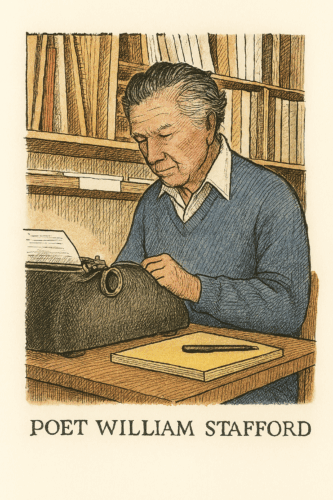
And maybe more than his writings, it’s his life that is his greatest witness, a call to be human, one word and sentence at a time.
To learn more about William Stafford, check out the site, Friends of William Stafford.
And to read some poetry, go to his Poetry Foundation page.
[1] https://www2.csudh.edu/ccauthen/451S12/staffort.html