
The following are excerpts from remarks delivered by political commentator Hugh Hewitt on
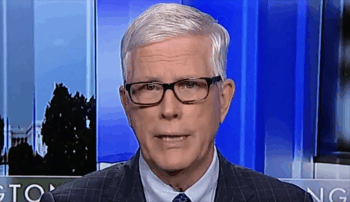
his radio talk show carried by the Salem Radio Network, on December 8, 2025.
It occurred to me last night, as the fetching Mrs. Hewitt and I were at our highest and best uses, babysitting, driving home pretty late from where we were babysitting, that there were many Christmas lights out.
I realized lots of people don’t know why we do Christmas lights, or what it’s all about. They know it’s the holiday season. We don’t live in a post Christian age. We live in an anti-Christian age. We live in an actually post post Christian age, one that is resolutely secular. Some would say secular absolutism is our media’s religion, and I would agree with them, but nevertheless, most Americans still believe that Christmas is real, about a real event that happened.
Here’s the short summary of why we are here. There are always two stories, why you are where you are individually and why the world is where it is collectively, and it’s mostly history. It’s a little bit of theology, but it’s mostly history.
There’s a logic embedded in the United States Declaration of Independence and Constitution that takes a little bit of teasing out, but mostly it’s history with a little bit of logic.
Basics: The Big Bang happened 13.8 billion years ago. Science agrees that 13.8 billion years ago everything got started with the Big Bang. Now who’s the prime mover? We think it’s God. Christians believe it’s God. So do Jews, and I think Muslims do as well.
About 4.5 billion years ago, the Earth was formed, and Homo sapiens began walking around on it about 200,000 years ago. So mankind has been on the earth a relatively short period of time now. Whenever Homo sapiens developed consciousness, the first thing they encountered was the natural law. That’s actually what sets us apart from the animals, is that we have a conscience, a recognition of natural law, and as soon as we realized it, we broke it.
We are people of free will, and inevitably, every single one of us, me, you, we screw up and we break the natural law that is encoded into the universe by the Big Bang’s Creator. The Big Bang Creator created a natural law. Inevitably we screw up. Recognizing that, God the Creator, chose the Jewish people as a chosen people from which to draw a Savior of the world that was fallen and suffering in darkness.
It took a long time, from 200,000 years (ago) to roughly 6 AD for Jesus to appear. And by the way, this is where the Jews leave us. Our brothers and sisters in the Jewish faith don’t believe the Messiah has come. Christians believe the Messiah has come to demonstrate the right way to act, to demonstrate how to live, and to be the ultimate sacrifice for all the bazillion, gazillion errors, mistakes, and crimes that we commit, every one of us, we all violate the natural law. We all choose to do it, and we try not to, but we all break the natural law.
God gave the Jews the Ten Commandments as a head start. He said, ‘Moses here, if you can just get this down, this will work.’ And that did not work. It worked all right, it’s still good law. It still matters. Not a jot or a tittle of the law has gone away, but we still break the Ten Commandments.
So then God sent into the world at Christmas, roughly around 4-6 AD, Jesus, born of Mary, a virgin. This is what Christians believe, and I believe it, and everyone who calls themselves a Christian believes it.
The pagan Romans were in charge of the place where he was born. He was born in Bethlehem, not in his hometown of Nazareth. It’s close to Jerusalem, and that was occupied by Rome at that time. There’s a great book called The Jews and the Romans, which I will recommend to you. I’m listening to it right now. Judea was part of the Roman Empire, and it was run by the Romans, and the Romans let local political groups fight it out among themselves, as was the case, but the Romans killed Jesus… he was too much of a headache for them.
Christians believe Jesus rose from the dead on Easter, but they believe he was born on Christmas, and the Christmas story is what we are celebrating, because light comes into a broken and dark world, one that guarantees those who believe in the light in Jesus, will eventually enjoy an infinite amount of greatness with God. That’s the whole story.
People who ask forgiveness for their breaking of the natural law receive it, and those who don’t believe it fall into two categories, those who scorn it, and I don’t know what happens to them, and those who don’t know, and I’m hoping that they get in with a Get Out of Jail Free card of some sort.
The last category of people, those who believe it ought to evidence in their lives the fact that they believe the gospel. But the entire Christmas season is about people who believe that Jesus was born of the Virgin Mary, roughly, in the early years of AD, or, as the secular absolutists like to say, CE, the Common Era. I don’t really care. It doesn’t change the history; Jesus was born. His birth was attested to, not just by the Gospels, the most attested thing in the world.
In fact, Josephus, a Jewish Roman historian at the time, wrote it all up, put it all down at the same time, when he was cataloging the ups and downs of the great Jewish wars, and Romans and Jews did not get along very well, but there were periods of great peace, and then there were periods of great slaughter, and at the end of it, it all came together.
Now flash forward, Jesus born around AD 4-6, something like that. That’s for the scholars to decide. No doubt about it, he was born. The accounts of his life are there, and the church gets going. It’s persecuted for 300 years or so. And then Constantine makes it the official religion and Christianity takes over Europe. A lot of the (European) world gets bigger and bigger. It becomes only Christianity.
Around 1500 Luther shows up, and Christianity breaks apart into its own many denominations. all of which believe Jesus is born of a virgin on Christmas. Every single Christian denomination believes that. If it doesn’t believe that, it’s not a Christian denomination. And so that’s why we’re celebrating Christmas.
How does that tie into what happened today at the Supreme Court? They had an argument about the Constitution. When the country was founded, it was founded by Anglicans and Puritans. By the country, I mean America. The Anglicans went to Virginia. The Puritans went up north, different kinds of Christians, but Christians, nonetheless, the people who put together the revolution did so after the Great Awakening, the very religious time in the country, the first Great Awakening.
They believed in God-made natural rights …They believed in the laws of nature, and nature’s God, and nature’s God was in charge. And there are a variety of different Christians who decided we needed to break away from England. And then there were a variety of Christians when they framed the Constitution in 1787.
George Washington, like almost all the framers, were one flavor of Christian or another. That’s why Christmas has always mattered in America, because the framers believed it, and the framers wrote the Declaration of Independence, and more importantly, the Constitution, on the premise that the American people would be a morality-based people, not a Christian people.
We have a first amendment that guarantees your right to exercise any kind of religion you want, but we are a Christian people by and large, and we remain majority Christian. The constitution is not hard to read, and it’s all based on that one premise, and this season is all based on that one premise, that Jesus was born in Bethlehem, approximately 2025 years ago, without which all of it makes no sense whatsoever.
So welcome to Christmas. That’s my annual little reminder of the reason for the season.
If you want to know more about a personal relationship with God, go here
Hugh Hewitt is a political commentator, radio talk show host with the Salem Radio Network, attorney, academic, and author. He writes about law, society, politics, and media bias in the United States. Hewitt is a former official in the Reagan administration, the former president and CEO of the Richard Nixon Foundation, a law professor at Chapman University School of Law, a former columnist for The Washington Post, and a regular political commentator on Fox News. He is the 14th most-listened-to radio talk show host in the United States.


The author says we live in an anti-Christian age; yet almost all of the article depicts a USA that overwhelmingly Christian. After the opening strong assertion about our being “anti-Christian,” the article depicts the growth and perpetuation of America’s commitment to Christianity. I was drawn into reading the article hoping to read more details about how anti-Christian “pushback” manifests. Also, I found the breezy tone of the article less than satisfying. It is almost, but not quite, flippant — as though the author understands that he is giving a too brief and too non-specific “history” of Christianity in America. So overall, the article is correct, but unsatisfying.
Comments are closed.