By Mark Ellis —
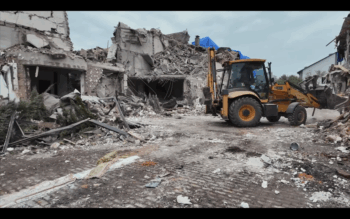
As the first snowfall blankets the war-torn streets of Kharkiv and Kyiv, Russian missiles once again target Ukraine’s fragile power grid, plunging millions into darkness that feels as cold as the Siberian winds.
In what military analysts call a calculated “winter weaponization” strategy, Moscow has unleashed over 1,200 drones and missiles on energy infrastructure since October 2025 alone—destroying 70% of Ukraine’s thermal power capacity and leaving families to huddle by candlelight amid sub-zero nights, according to a November 5, 2025 report by the International Energy Agency.
“Russia is using winter as a weapon of mass deprivation,” Ukrainian President Volodymyr Zelenskyy declared in a video address from a darkened bunker, his breath visible in the frigid air.
The Kremlin’s playbook is chillingly precise: strike substations, dams, and gas pipelines just as temperatures plummet, forcing blackouts that cripple hospitals, water pumps, and heating systems. In Kherson, where Russian shelling cut power to 80% of the city, Pastor Oleksandr Kovalenko of Grace Baptist Church said his congregation now holds services by flashlight.
The United Nations verified that 12 million Ukrainians—nearly a third of the population—face daily blackouts of up to 20 hours, with children studying by headlamp and elderly believers praying for relief.
Jeff Thompson, founder of Mercy Projects, recently returned from Ukraine, where he experienced four-hour blackouts where he stayed, and eight-hour blackouts in other buildings he visited. “They are targeting energy and power stations for the purpose of creating outages — and terror,” he told God Reports. His ministry is supplying generators, firewood, and comforters to supply warmth.
In Mykolaiv, where the central heating plant was obliterated on October 29, a network of evangelical churches has converted basements into “warm hubs,” distributing 5,000 blankets, 2,000 generators, and hot meals cooked over camp stoves—efforts coordinated by the Ukrainian Baptist Union and funded in part by Samaritan’s Purse.
As Russian President Vladimir Putin boasts that “winter will do what missiles cannot,” Ukrainian believers counter with worship that echoes through the blackouts—choirs singing “Great Is Thy Faithfulness” in unheated cathedrals. Mission Eurasia reports that 40 new house churches have sprouted in bomb shelters since October, with 1,200 baptisms in icy rivers despite the cold.
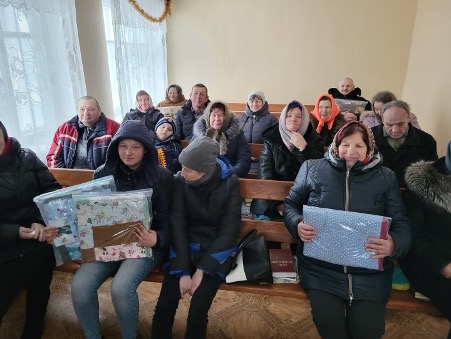
Convoy of Hope has delivered 300 solar-powered lanterns to pastors in Donetsk, while Open Doors USA smuggles thermal underwear and gospel tracts across the front lines. “Every blanket is a sermon,” says Open Doors field worker “Marta,” who risks arrest to reach isolated villages (Open Doors Ukraine Briefing, November 5, 2025).
The Slavic Gospel Association (SGA) has launched its winter Heat & Hope campaign — an effort to supply local evangelical churches across Ukraine with generators so they can double up as “warming centers,” providing warm places for people to gather, rest, and also find hope.
“My family in Ukraine stays without heating and light for half of the day,” said Oleksandra Abramchuk, a young mother from Kiev, currently living in the U.S. “Imagine families with kids in the winter — no heating, no light, you cannot keep your children warm, sometimes going days without a hot meal.”
In one northern village near the Belarusian border, Peter—a longtime SGA-supported pastor—has become a symbol of resilience. When his church received a generator after months in the dark, he hitched it to a trailer and set out across the snow. “I will not only provide power to my church,” he said. “There are two other villages where I pastor. Wherever I go, there is heat and hope.”
The need for generators — costing about $2,800 a piece — is even more critical this winter, when major parts of Kiev, the capital, are likely to be without electricity.
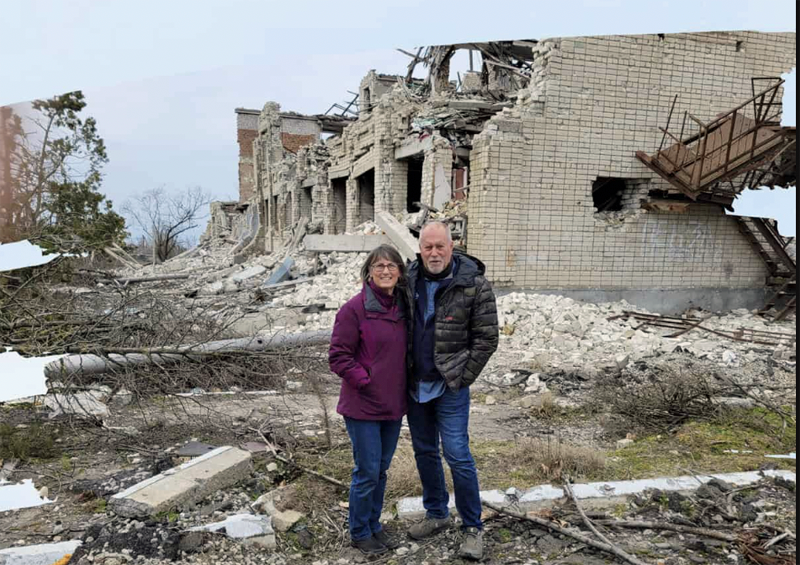
Meanwhile, in remote villages near the frontlines, many families are living in homes badly damaged by explosions. Local pastors brave the danger to deliver firewood and coal, often sharing the Gospel in the open air as villagers collect fuel for fires.
“Even in the coldest conditions, people come to church bundled up in thick coats and blankets to sing and pray together,” Eric Mock, VP of Operations for SGA said. “They thank God they’re alive.”
SGA supports more than a hundred local missionary pastors across Ukraine, and its local evangelical church network has distributed more than five million meals since the conflict began.
“In a world that is frozen and without hope, every flicker of warmth tells people they’re not forgotten.”