By Mark Ellis —
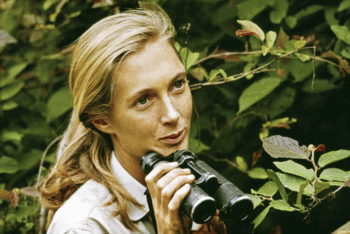
Jane Goodall, the world-renowned primatologist, zoologist, and anthropologist, whose groundbreaking work with chimpanzees revolutionized our understanding of primates, slipped into eternity while in Los Angeles on a speaking tour of the US. She was 91.
She left a group in Pasadena expecting to hear from her in tears when they learned she passed away before her visit, according to the LA Times.
Born Valerie Jane Morris-Goodall on April 3, 1934, in London to Mortimer Morris-Goodall, a businessman, and Margaret Joseph, a novelist, whose stories of adventure ignited her daughter’s imagination.
Raised in the Congregational church, her family were occasional churchgoers, but Goodall began attending more regularly as a teenager when the church appointed a new minister, Trevor Davies. “He was highly intelligent, and his sermons were powerful and thought-provoking… I could have listened to his voice for hours… I fell madly in love with him… Suddenly, no one had to encourage me to go to church. Indeed, there were never enough services for my liking,” she wrote in her book, A Reason for Hope, A Spiritual Journey.
When she later discovered that many of her scientific colleagues were atheists or agnostics, she wrote, “fortunately, by the time I got to Cambridge I was twenty-seven years old, and my beliefs had already molded so that I was not influenced by these opinions.”
She had a powerful encounter with God at Notre Dame Cathedral in 1977: “Since I cannot believe that this was the result of chance, I have to admit anti-chance. And so, I must believe in a guiding power in the universe – in other words, I must believe in God.”[1]
When asked in 2010 if she still considered herself a Christian, Goodall told the Guardian “I suppose so; I was raised as a Christian,” and stated that she saw no contradiction between evolution and belief in God.
In her foreword to the 2017 book The Intelligence of the Cosmos by Ervin Laszlo, a philosopher of science who advocates quantum consciousness theory, Goodall wrote: “we must accept that there is an Intelligence driving the process [of evolution], that the Universe and life on Earth are inspired and in-formed by an unknown and unknowable Creator, a Supreme Being, a Great Spiritual Power.”
The same year she told Christianity Today, “I was brought up as a Christian, and I have always believed in God… Nature is my temple.”
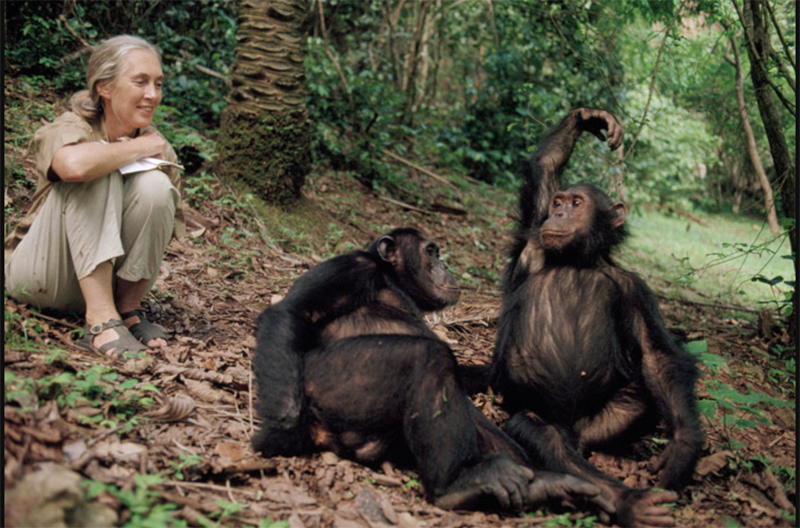
That temple called her to Tanzania in 1960, at age 26, armed with little more than a notebook and a voracious curiosity. Under the mentorship of paleontologist Louis Leakey, she ventured into Gombe, renaming herself “Jane” to blend with the locals, and there, amid the chimpanzees she would immortalize, she made significant discoveries.
Her breakthrough came in 1960, observing a chimp named David Greybeard fashioning a twig into a termite tool—a “eureka” moment that shattered the idea of human uniqueness when it came to using tools.
Goodall’s research, detailed in her book In the Shadow of Man (1971), revealed chimps’ capacity for emotions, warfare, and even “religion”—stacking stones in what she called “cascades of stones,” resembling primitive pagan worship.
But it was her activism that amplified her voice into an iconic status. In 1977, she founded the Jane Goodall Institute, channeling Psalm 96:11-12’s call—”Let the heavens rejoice, let the earth be glad… let all the trees of the forest sing for joy”—into Roots & Shoots, a youth program now in 100+ countries empowering young people to be good stewards of the planet. “We have a choice,” she urged in Reason for Hope, attributing her optimism to “the indomitable human spirit” and “the power of God.”
Through wars, pandemics, and personal trials—including the 1986 arson attack on her Gombe research center, Goodall remained steadfast. Knighted Dame Commander of the Order of the British Empire in 2004, she crisscrossed the globe, lecturing at the United Nations and TED Talks, always with a chimpanzee accompanying her as a reminder of innocence lost to poaching and habitat destruction.
Her Christian convictions shone in moments like her 2019 address to the Yale Forum on Religion and Ecology, where she declared, “If we could only see the world through the eyes of a child, we would see the glory of God in every leaf and creature.”
Some criticized her blend of science and faith as naive, but as she quipped in her Guardian interview, “Science can tell us how, but only faith tells us why.” That why—rooted in the Creator’s mandate to steward the earth (Genesis 2:15)—drove her to forgive even the poachers who ravaged her beloved forests, modeling the forgiveness of the cross.
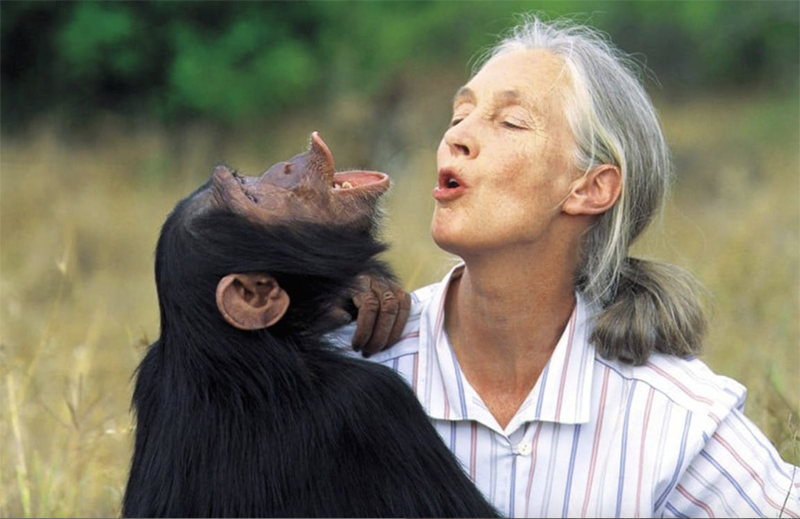
Goodall’s legacy continues through the lives of countless youth who, through her programs, have planted millions of trees and advocated for endangered species.
She leaves behind a daughter, Grub (Hugo Eric Louis van Lawick), from her first marriage to photographer Hugo van Lawick; a grandson; and a second husband, Mohamed bin Jamil, married in 2020. Her only child, Grub, shared in a statement: “My mother taught me that hope is the heartbeat of change, a gift from God to those who dare to dream.”
- Goodall, Jane (15 April 2019). “Dr. Goodall’s thoughts on the fire of Notre Dame”. Jane Goodall Institute.