By Mark Ellis —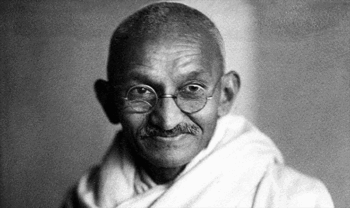
As the world grapples with rising violence and division, some may be surprised to learn that Mahatma Gandhi’s nonviolent resistance was influenced by the teachings of Jesus Christ, particularly the Sermon on the Mount.
Gandhi enunciated a philosophy of truth and love called satyagraha that toppled the British empire without bloodshed. While he was rooted in Hinduism, Gandhi’s encounter with Jesus’ call to “turn the other cheek” transformed his opposition to British colonial rule.
Born in 1869 in Gujarat, India, Mohandas Gandhi grew up steeped in Hinduism and Jainism, traditions that prized ahimsa—nonviolence toward all living beings.
Yet it was during his time in London (1888–1891), studying law, that Gandhi first encountered the New Testament, a moment that would reshape his life.
“The Sermon on the Mount went straight to my heart,” he wrote in his autobiography, The Story of My Experiments with Truth. The words of Jesus in Matthew 5:39–40—“If anyone slaps you on the right cheek, turn to them the other cheek also”—struck him powerfully, feeding into his growing conviction that love could conquer oppression.
In South Africa (1893–1914), where Gandhi faced racial injustice as an Indian lawyer, his awareness of Christianity deepened. Christian friends, including missionary Charles Andrews, further introduced him to Jesus, whose example of sacrificial love resonated with the young attorney.
Gandhi attended church services, studied the Gospels, and also read Leo Tolstoy’s The Kingdom of God Is Within You, which interpreted Jesus’ teachings as a call to resist evil nonviolently. “Tolstoy’s book showed me how Jesus’ love could be a practical force,” Gandhi wrote, inspiring his first satyagraha campaigns against discriminatory laws (Christianity Today, 2019).
Gandhi called Jesus the “Prince of Satyagrahis,” admiring his willingness to suffer for truth without retaliation. The Sermon on the Mount, with its call to love enemies (Matthew 5:44), became a cornerstone of satyagraha, blending with ahimsa and Jain principles of compassion.
“I have no desire to criticize Christianity,” Gandhi said in 1927. “The Jesus I love is the Jesus who lived and taught” (Hindu, 1940).
Yet, sadly, he remained Hindu, rejecting Jesus as his personal Savior and Lord, while embracing Jesus’ ethics, a stance that shaped his Salt March (1930) and Quit India movement (1942), which mobilized millions against British rule (BBC, 2020).